

Human Health
Edible Probiotics
High viable cell count
Edible Probiotics
Diverse strains – formulated with a wide variety of probiotic strains
Multiple supportive functions – including support for normal digestion, bowel regularity, reduction of bloating, and maintenance of normal liver function

Pleasant taste – designed for good palatability and consumer acceptance
Rapid onset – some users may notice effects within approximately 2 hours
Functional Attributes of Probiotic Strains
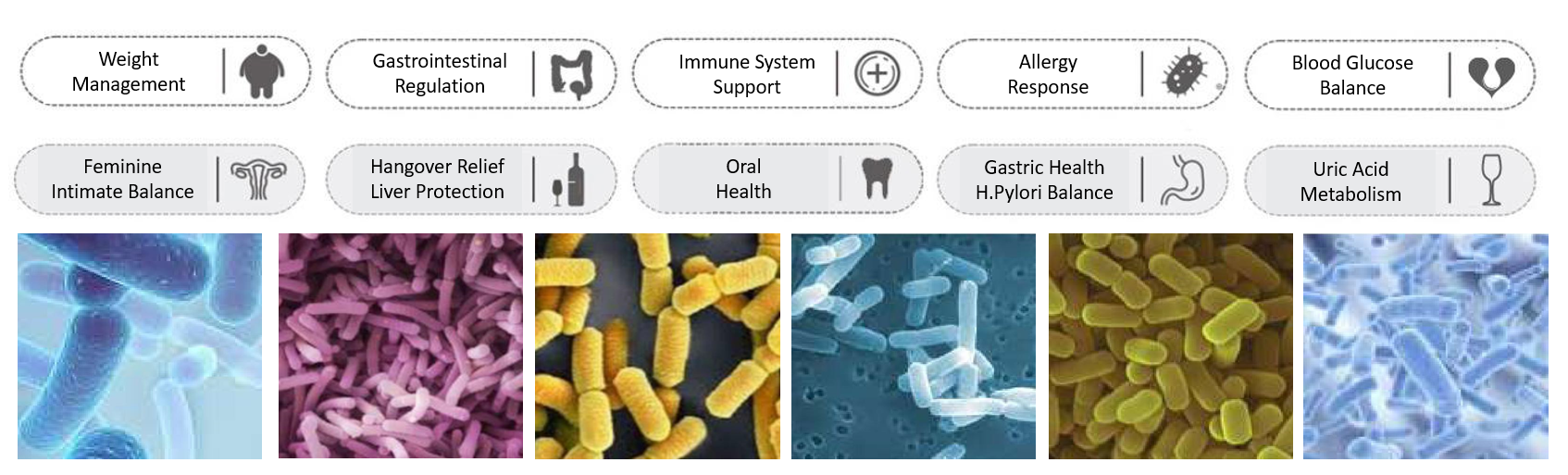
Beyond gastrointestinal health, we are conducting functional validation of probiotic strains across ten targeted health-support areas, including weight management and gastric health support, and have progressively advanced these strains toward scalable commercialization.
Catalogue of Food-Grade Probiotic Strain Repository
| No. | Genus/Species | Strains | No. | Genus/Species | Strains | No. | Genus/Species | Strains | No. | Genus/Species | Strains |
|---|---|---|---|---|---|---|---|---|---|---|---|
| Bifidobacterium | 960 | 12 | Lactobacillus gasseri | 206 | Streptococcus | 16 | 32 | Pediococcus acidilactici | 9 | ||
| 1 | Bifidobacterium Adolescentis | 532 | 13 | Lactobacillus helveticus | 39 | 25 | Streptococcus thermophilus | 16 | 33 | Pediococcus pentosaceus | 9 |
| 2 | Bifidobacterium animalis subsp. animalis | 0 | 14 | Lactobacillus johnsonii | 38 | Lactococcus | 6 | Weissella | 13 | ||
| 3 | Bifidobacterium animalis subsp.lactis | 24 | 15 | Lactobacillus kefiranofaciens subsp. kefiranofaciens | 0 | 26 | Lactococcus lactis subsp. lactis | 0 | 34 | Weissella confusa | 13 |
| 4 | Bifidobacterium bifidum | 305 | 16 | Lactobacillus casei | 5 | 27 | Lactococcus lactis subsp. lactis biovar diacetylactis | 0 | Mammaliicoccus | 0 | |
| 5 | Bifidobacterium breve | 69 | 17 | Lactobacillus paracasei | 38 | 28 | Lactococcus cremoris | 6 | 35 | Mammaliicoccus vitulinus | 0 |
| 6 | Bifidobacterium longum subsp.Infantis | 17 | 18 | Lactobacillus rhamnosus | 14 | Propionibacterium | 0 | Staphylococcus | 0 | ||
| 7 | Bifidobacterium longum subsp. longum | 13 | 19 | Lactobacillus fermentum | 41 | 29 | Propionibacterium freudenreichii subsp. shermanii | 0 | 36 | Staphylococcus xylosus | 0 |
| Lactobacillus | 1318 | 20 | Lactobacillus reuteri | 5 | Propionigenium | 0 | 37 | Staphylococcus carnosus | 0 | ||
| 8 | lactobacillus acidophilus | 16 | 21 | Lactobacillus plantarum | 221 | 30 | Propionibacterium propionicum | 0 | Kluyveromyces | 0 | |
| 9 | Lactobacillus crispatus | 529 | 22 | Lactobacillus salivarius | 66 | Leuconostoc | 20 | 38 | Kluyveromyces marxianus | 0 | |
| 10 | Lactobacillus delbrueckii subsp.bulgaricus | 3 | 23 | Lactobacillus curvatus | 30 | 31 | Leuconostoc mesenteroides subsp.mesenteroides | 20 | Sum | 2351 | |
| 11 | Lactobacillus delbrueckii subsp. lactis | 0 | 24 | Lactobacillus sakei | 51 | Pediococcus | 18 | ||||
This catalogue lists microbial strains for research classification purposes.
Single-strain Potency Specification
| Genus | Species | Potency(CFU/g) |
|---|---|---|
| Lactobacillus | Lactobacillus plantarum | 9.0 × 10¹¹ |
| Lactobacillus plantarum | 5.0 × 10¹¹ | |
| Lactobacillus paracasei | 5.0 × 10¹¹ | |
| Lactobacillus fermentum | 3.0 × 10¹¹ | |
| Lactobacillus reuteri | 1.0 × 10¹¹ | |
| Lactobacillus acidophilus | 1.0 × 10¹¹ | |
| Lactobacillus rhamnosus | 8.0 × 10¹¹ | |
| Lactobacillus crispatus | 1.0 × 10¹¹ | |
| Lactobacillus helveticus | 1.0 × 10¹¹ | |
| Lactobacillus salivarius | 3.0 × 10¹¹ | |
| Bifidobacterium | Bifidobacterium lactis | 6.0 × 10¹¹ |
| Bifidobacterium longum | 1.0 × 10¹¹ | |
| Bifidobacterium breve | 1.0 × 10¹¹ | |
| Bifidobacterium bifidum | 1.0 × 10¹¹ | |
| Bifidobacterium adolescentis | 1.0 × 10¹¹ | |
| Bifidobacterium infantis | 1.0 × 10¹¹ | |
| Pediococcus | Pediococcus acidilacticl | 1.0 × 10¹² |
| Bacillus | Bacillus coagulans | 1.0 × 10¹¹ |
Microbial Inoculant Characteristics
Diverse Functional Strains
1
Broad-spectrum microbial consortia tailored to specific agricultural and environmental challenges, enabling precise and scenario-based formulation design.
Ultra-High Viable Cell Density
2
Formulated to deliver ≥ 6 × 10¹¹ CFU/g of active microorganisms, which is substantially higher than the typical commercial microbial formulation range (commonly 10⁸–10¹⁰ CFU/g).
Rich Bioactive Metabolites
3
Abundant production of organic acids, polysaccharides, enzymes and antimicrobial peptides ensures sustained biological activity and stable field performance.
5
Spore-Based High-Stability Technology
Fully Water-Soluble Formulation
4
Rapid dispersion in water, ensuring uniform application across irrigation, spraying and soil incorporation systems.
Endospore-dominant formulation provides superior resistance to heat, desiccation and storage stress.
FAQs
Strategic Value of Microbial Inoculant for
Sustainable Agriculture & Environmental Management
Reducing Dependence on Chemical Inputs
Microbial inoculants provide a renewable, biological alternative to chemical fertilizers and pesticides, supporting long-term soil health, reducing environmental contamination, and lowering agricultural chemical dependency.
Protecting Public Health and Food Safety
By replacing high-risk chemical controls with beneficial microorganisms, microbial inoculants help reduce food-borne contamination risks and support safer, cleaner agricultural production systems.
Transforming Waste into Resources
These microbial technologies enable the biological conversion of agricultural, livestock, and food waste into reusable resources, supporting circular economy models and improving rural and urban environmental quality.
Our Approach

Discovery
Identifying functional microbial strains with beneficial
biological properties across diverse ecosystems.

Validation
Working with third-party laboratories and
scientific testing to evaluate safety and effectiveness.

Development
Formulating microbial solutions optimized for
stability, performance, and real-world environments.

Deployment
Applying microbial technologies across
agricultural, environmental, and biological systems.
Advancing the Next Phase of Microbial Innovation
As global systems evolve, we remain committed to advancing microbial technologies that address emerging agricultural, environmental, and biological challenges.
Interested in collaboration or technology partnerships?
We welcome research collaborations and strategic partnerships that advance microbial innovation across industries.