

Core Mechanisms of Microbial Action
1
Resource competition
Outcompete pathogens for nutrients and colonization sites
2
Antimicrobial activity
Secrete inhibitory metabolites
3
Mycoparasitism
Directly parasitize pathogenic fungi
4
Plant growth promotion
Enhance plant vigor and stress tolerance
5
Induced resistance
Activate plant immune responses
6
Microbial lysis
Degrade and disrupt pathogen cells
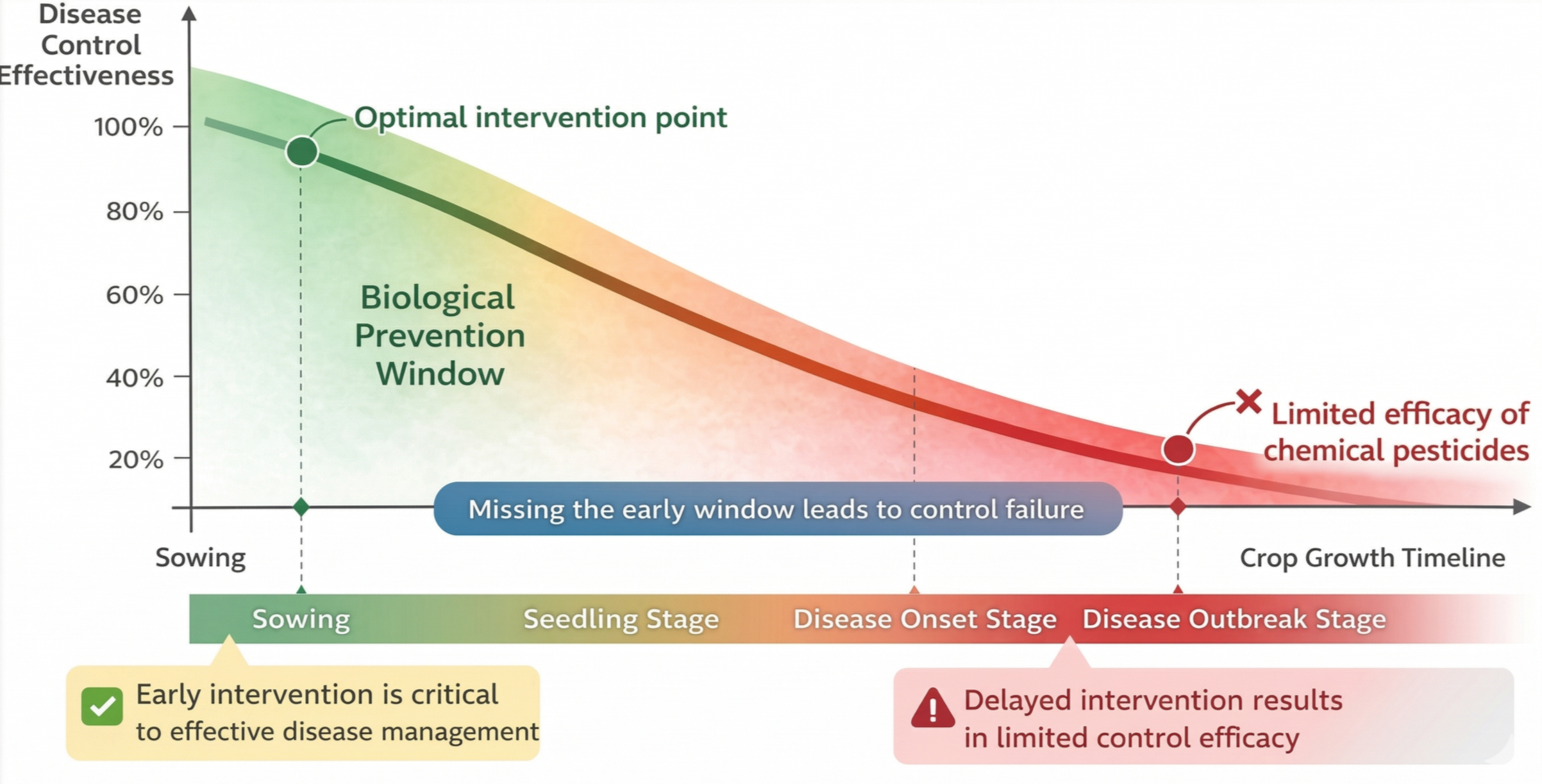
Prevention First: The Key to Reducing Pesticide Use
Key Functional Microbial Groups
Mechanisms of Microbial Disease Control
-
Bacillus strains exhibit strong antagonistic activity against soil-borne pathogens, demonstrate high survivability in soil environments, possess strong rhizosphere colonization capacity, and proliferate rapidly.
They are capable of inducing systemic resistance in plants while promoting root development and overall plant growth. Representative species include Bacillus subtilis, Bacillus amyloliquefaciens, and Bacillus laterosporus, all of which are endospore-forming bacteria with high environmental adaptability.
-
Species including Trichoderma harzianum, T. viride, T. koningii, T. hamatum, and T. longibrachiatum exhibit significant biocontrol potential against soil-borne diseases.
When applied in combination with Bacillus species, they demonstrate superior control performance for root-related diseases compared with conventional chemical fungicides, while contributing to crop yield stability.
-
Approximately 70% of antimicrobial compounds derived from microbial metabolism originate from actinomycetes.
Among them, the genus Streptomyces is particularly notable for its outstanding disease suppression capability and its important role in sustainable plant disease management.
Representative Functional Strains
Bacillus Strains
-
Special treatments including sporulation enhancement and microencapsulation are applied to the strain, giving it excellent stability in spore form. It is resistant to oxidation, compression, and high temperatures — capable of tolerating prolonged exposure to 140°F (60°C) and surviving at 248°F (120°C) for up to 20 minutes. It is also tolerant to acidic and alkaline conditions, remains active in acidic environments, and can withstand exposure to saliva and bile.After entering the soil in spore form, Bacillus subtilis rapidly revives from dormancy and multiplies into a high-density dominant population within a short period. During this process, it consumes large amounts of oxygen in the soil and produces hydrogen peroxide and bacteriocins, establishing a microbial ecological balance, promoting the growth of beneficial anaerobic microorganisms, and suppressing harmful bacteria such as Escherichia coli and Salmonella.
During rapid proliferation, it produces a wide range of vitamins, organic acids, amino acids, and enzymes — including proteases (particularly alkaline protease), saccharifying enzymes, lipases, and amylases. These metabolites help decompose complex organic matter in the soil, promoting crop nutrient absorption and improving fertilizer use efficiency.
Safe and highly effective — no pesticide residues, no toxic side effects. It reduces reliance on antimicrobial pesticides and enhances plant immunity.
It demonstrates strong control efficacy against soil-borne diseases in fruit trees, melons, solanaceous crops, ginger, potato, Chinese yam, Panax notoginseng, and ginseng — including Fusarium wilt, Verticillium wilt, and root rot, as well as potato late blight and banana Panama disease (Fusarium wilt). The variant Bacillus methylotrophicus shows particularly strong preventive and curative effects against various soil-borne diseases, especially powdery mildew, root rot, and continuous-cropping disorders.
-
Bacillus amyloliquefaciens has strong disease-suppressive and antimicrobial activity. It can secrete more than a dozen antifungal substances, including lipopeptide antibiotics, antifungal proteins, and surfactin. These secretions interact physically and chemically with the lipid membranes of pathogens, disrupting membrane structure, causing leakage of intracellular contents, and ultimately leading to cell death. It can effectively inhibit plant pathogenic fungi and strongly suppress their activity, while also preventing sclerotial germination and mycelial growth in Sclerotinia species.
It can effectively suppress or alleviate a wide range of plant diseases, including wheat sharp eyespot, cotton wilt, cotton red rot, cotton Verticillium wilt, cucumber gray mold and blight, rapeseed and celery sclerotinia, rice blast, pepper wilt, yam root rot, apple anthracnose, ring rot, canker, brown spot, and many other crop diseases.
After application, concentrated Bacillus amyloliquefaciens powder can rapidly multiply and colonize the soil in large numbers, effectively excluding and blocking pathogenic microorganisms from infecting plants. At the same time, it secretes extracellular metabolites that directly kill or inhibit pathogen growth and reproduction. By attaching to pathogen cells, it can produce lytic substances that break down hyphae and cell walls, causing cell rupture, disintegration, perforation, and deformation. It can also induce the plant’s own disease-resistance potential, enhance plant immunity, stimulate the secretion of growth-promoting substances, and thereby support crop growth, yield improvement, and income increase.
In addition, Bacillus amyloliquefaciens shows a clear degradation effect on butachlor. The higher the initial concentration of butachlor, the higher the degradation rate and efficiency. Degradation is significantly better under alkaline conditions than under acidic conditions. The addition of humic acid not only adsorbs butachlor, but also promotes its microbial degradation and influences the resulting degradation products.
-
1.Improves the soil microecological environment.
2.Enhances thickening, lignification, and strengthening of plant tissue cell walls. It can also help form a cuticle–silica double layer on the epidermis, creating a barrier against pathogen invasion.
3.Converts insoluble phosphorus into available phosphorus, thereby improving phosphorus uptake efficiency in soil.
-
Metabolites produced by methylotrophic Bacillus—especially antifungal lipopeptide compounds—have strong antimicrobial activity against fungal plant diseases. They show remarkable control effects against cucumber and tomato gray mold, late blight, cotton yellow wilt and Fusarium wilt, and apple canker, and can also help control citrus canker, cucumber angular leaf spot, and rice bacterial leaf streak.
This strain can also produce aminopeptidase-like substances and act as a PGPR (plant growth-promoting rhizobacterium) to promote plant growth.
-
1.Competitive action
Endophytic Bacillus cereus competes with pathogens for colonization sites and nutrients, thereby suppressing plant diseases. Since its route of entry into the plant is similar to that of pathogens, it can occupy infection sites first and compete directly with pathogens for resources.
2.Antagonistic action
Through metabolic activity, it produces antimicrobial substances that inhibit pathogen growth or kill pathogens directly. It can secrete a variety of antifungal and antibacterial antagonistic compounds, including novel cyclic antifungal polypeptides (APS), which have a broad antimicrobial spectrum and persistent inhibitory activity, significantly suppressing spore germination and hyphal growth of pathogenic fungi.
3.Induction of plant resistance
(1)It can induce physical resistance structures in host plants, leading to the accumulation of lignin and phenolic substances at attempted infection sites, thereby thickening cell walls and effectively blocking pathogen invasion.
(2)It can also trigger physiological and biochemical changes in host plants, including the accumulation of related proteins and the production of hydrolytic and oxidative enzymes such as chitinase, β-1,3-glucanase, and peroxidase, thus suppressing pathogen growth.
(3) Bacillus cereus can secrete superoxide dismutase (SOD), helping plants develop enhanced resistance to pathogens.
-
Biological Control of Diseases
1.Control of multiple fungal and bacterial diseases
This strain has been studied for its potential role in managing a range of fungal and bacterial diseases, including banana wilt, rice blast, cucumber wilt, pepper blight, root rot, damping-off, and other crop-related diseases. Commercial products based on this species have also been used in disease management programs involving soybean Fusarium wilt, anthracnose, and rice sheath blight.2. Nematode control
Certain strains or strain-based products may also exhibit nematicidal activity and have been studied for their potential to help manage cyst nematodes, root-lesion nematodes, and related soil-borne pests.3. Mode of action
This strain suppress pathogen development through multiple mechanisms, including the production of antimicrobial compounds such as bacillomycin D, competition for key resources such as iron, and the induction of plant systemic resistance.Promotion of Plant Growth
1. Yield improvement
Under suitable conditions, application of this strain may support crop growth, plant vigor, and yield-related performance. These effects can vary depending on crop type, soil condition, environmental factors, and field management practices.2. Enhanced nutrient uptake
After colonizing the rhizosphere, this strain may help form an active nutrient environment around plant roots, supporting nutrient transformation and availability. It may also secrete substances that influence nitrogen transport-related pathways, thereby supporting nitrogen uptake efficiency.3. Root stimulation
This strain can secrete growth-promoting substances such as IAA, or indole-3-acetic acid, which may support new root formation, root branching, and overall root absorption capacity.Soil and Environmental Improvement
1. Improved soil fertility
This strain contribute to soil fertility by supporting biological nitrogen fixation, phosphorus solubilization, and potassium mobilization. These functions can help transform nutrients into forms that are more accessible to crops and support overall soil biological activity.2. Soil remediation and protection
Certain strains have been studied for their potential role in reducing heavy metal uptake, supporting soil aggregate formation, and improving water and nutrient retention. These functions may contribute to healthier soil structure and improved long-term soil resilience.3. Support for green agriculture
As a component of microbial pesticides, biofertilizers, or soil health products, this strain can support more sustainable crop management systems. It may help reduce reliance on conventional chemical inputs while contributing to soil health, plant resilience, and environmentally conscious agricultural practices.
Paenibacillus Strains
-
1.It promotes the solubilization of phosphate and potassium ions, facilitating the conversion of insoluble mineral nutrients into soluble forms and enriching the available phosphorus and potassium content in the soil.
2.As a rhizosphere microorganism, it produces bioactive substances such as auxins and cytokinins that directly stimulate plant growth.
3.It produces antibiotic-like compounds that help reduce the incidence of crop diseases. Once Paenibacillus mucilaginosus establishes a dominant population in the crop rhizosphere, it effectively suppresses the growth of pathogenic microorganisms.
4.It generates large amounts of extracellular polysaccharides, which promote the formation of soil aggregates, improve soil texture, and enhance overall soil quality.
5.Bio-potassium fertilizers formulated primarily with Paenibacillus mucilaginosus have demonstrated strong yield-increasing effects on a wide range of crops grown in potassium-deficient soils. The strain also possesses nitrogen fixation capability.
-
1.It provides good control against soil-borne bacterial and fungal diseases.
2.It has a strong plant growth-promoting effect.
3.Paenibacillus polymyxa is particularly effective against bacterial wilt, a major bacterial soil-borne disease. In the late harvest stage, field control efficiency against bacterial wilt in tomato, eggplant, pepper, tobacco, potato, monk fruit, and ginger can reach 70%–92%.
Brevibacillus
-
1. Brevibacillus laterosporus promotes the proliferation of beneficial microorganisms in the root zone, suppresses pathogenic microbes, stimulates root growth, and enhances nutrient uptake capacity. It also activates soil nutrients through nitrogen fixation, phosphorus solubilization, and potassium mobilization, thereby increasing crop yield and improving crop quality.
2. Due to its tolerance to high temperatures, salinity, and both acidic and alkaline conditions, fertilizer drying temperatures during production can reach up to 500°F (260°C). This increases production output, reduces moisture content, and makes the strain fully compatible with industrial-scale manufacturing — operating under conditions identical to those used in standard compound fertilizer production. When incorporated into compound fertilizers, the inorganic nutrient content can reach 30%, while also enabling a reduction in nitrogen fertilizer input.
3. It exhibits exceptionally strong disease-suppressive capability, with particularly pronounced efficacy against fungal diseases and nematode infestations. It has earned the reputation of being the "Iron Guardian Against Continuous-Cropping Disorders."
4. The strain demonstrates excellent storage stability, with a degradation rate of less than 20% within 12 months.
Trichoderma & Beneficial Fungi
-
1.Competition
Trichoderma harzianum grows rapidly in the rhizosphere and phyllosphere, occupying colonization sites on plant surfaces and preventing pathogenic fungi from contacting roots and leaves, thereby protecting plants from infection.2. Hyperparasitism
During interaction with pathogens, metabolites secreted by host fungi guide Trichoderma harzianum toward the host fungus. Once recognized, the fungus establishes a parasitic relationship. Its hyphae grow parallel to and spiral around host hyphae, produce appressorium-like branches that attach to the host, and then secrete extracellular enzymes to dissolve the cell wall, penetrate the host hyphae, absorb nutrients, and ultimately kill the pathogen.3. Antibiotic effect
Trichoderma harzianum secretes certain antibiotic substances that inhibit pathogen growth and colonization, thereby reducing disease pressure.4. Plant growth regulation
Once colonized in the root system, it can produce plant growth-stimulating compounds, improve the root-zone microenvironment, enhance crop vigor and disease resistance, and increase yield and returns.5. Induction of plant resistance and activation of plant defense responses
It produces xylanase, which can trigger obvious defense responses in plants, including opening of K+, H+, and Ca2+ ion channels, ethylene synthesis, and PR protein accumulation. It also produces chitinase and β-1,3-glucanase, which play important roles in antagonizing plant pathogenic fungi. In addition, it activates plant defense responses that lead to the accumulation of phenolic compounds and lignin related to disease resistance. Proteases secreted by the fungus can degrade pathogens that break down plant cell walls, directly inhibit pathogen germination, inactivate pathogenic enzymes, and prevent invasion of plant cells. -
1. Promotion of plant growth
Purpureocillium lilacinum can produce abundant derivatives, including IAA-like substances. At low concentrations, its most notable physiological effect is the promotion of root and shoot growth. Colonization in the root system can significantly suppress nematode infection while stimulating vegetative growth and supporting seed germination and development.2. Production of multiple functional enzymes
It produces abundant chitinase, which degrades chitin and promotes nematode egg hatching, thereby increasing fungal parasitism of nematodes. It also produces cell-lysing enzymes, glucanase, and proteases that help promote cell division.3. Solubilization effect
It can promote the dissolution of insoluble phosphates, with phosphorus-solubilization efficiency reaching 30%, while nematode antagonism can reach 20%– 40%.4. Degradation effect
It can help degrade many chemical polymers, including pesticides and tannery wastewater-related compounds, and therefore has environmental protection value.5. Nematicidal and parasitic activity
After contacting nematode egg sacs, fungal hyphae surround the entire egg within a viscous matrix, and the hyphal tips swell. Due to the activity of exogenous metabolites and fungal chitinase, the eggshell surface ruptures, after which the fungus penetrates and replaces the egg contents. It also secretes toxins that exert toxic effects on nematodes.
Collaboration & Distribution Opportunities
Biotic Green works with agricultural producers, research institutions, and health-focused partners to develop and deploy microbial solutions across diverse markets.
We welcome strategic collaborations, distribution partnerships, and technology integration initiatives.